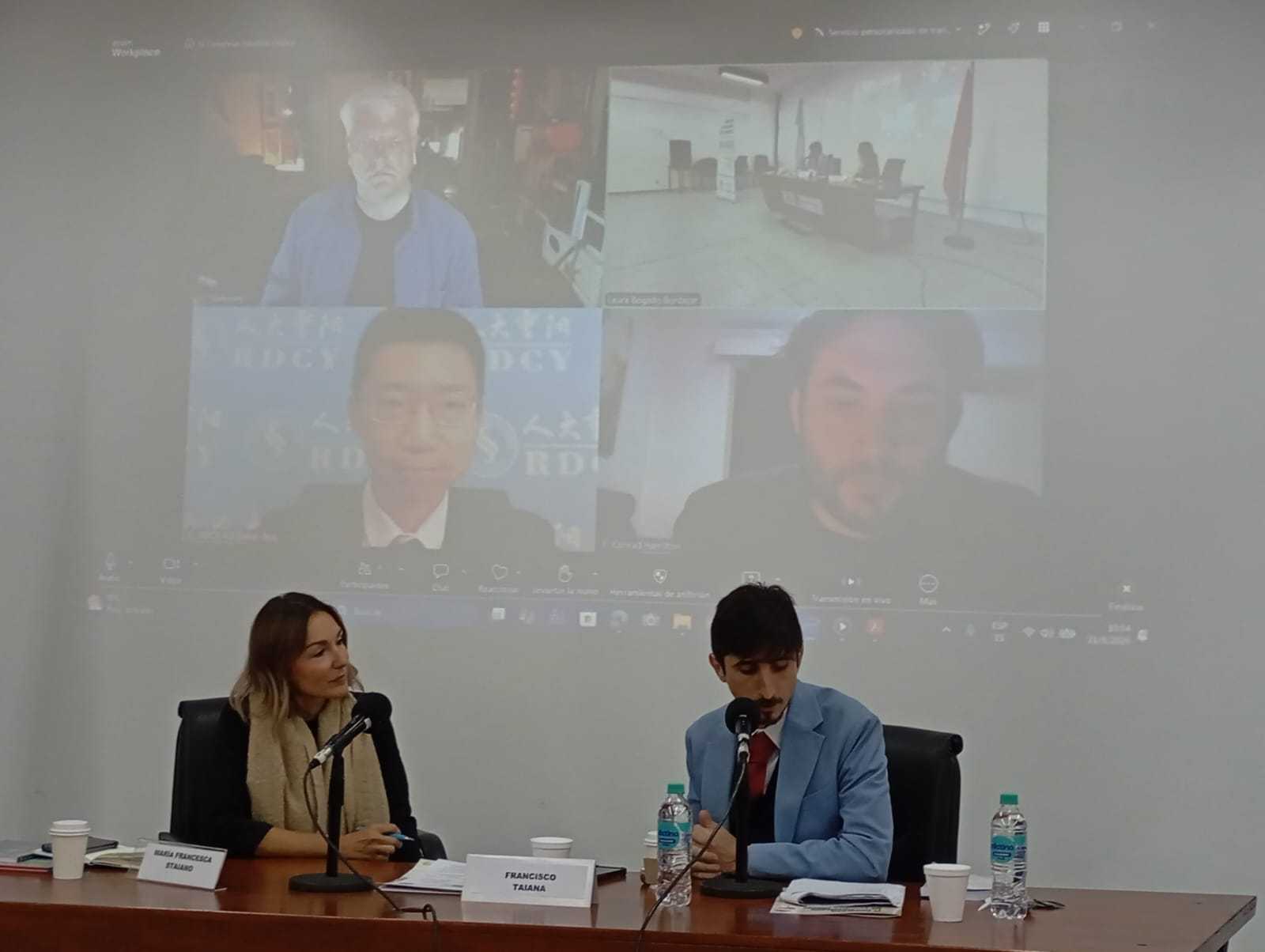
On August 21, 2026, the Center of Ecological Civilization co-sponsored a panel at the IV Congreso Latinoamericano de Estudios Chinos (“IV Latin American Congress on Chinese Studies”), held at the National University of La Plata, Argentina. Titled Diálogo sobre civilizaciones entre China y América Latina (“Dialogue on Civilizations between China and Latin America”), it featured 10-minute presentations from three members of the CEC: Director/Senior Research Fellow Josef Mahoney, Deputy Director/Assistant Research Fellow Conrad Hamilton, and Senior Research Fellow Maria F. Staiano.
The first of these was by Josef Mahoney, “The Jingwei Trap, New Internationalism, and Eco-Solidarity.” In recent years, U.S.-Chinese relations have often been analyzed through the prism of the “Thucydides Trap”—the idea that when a rising power threatens to displace an established power, the structural stress makes violent conflict a likely outcome. Yet as Mahoney points out, war is not a future possibility, but is already here, being fought not with “carrier strike groups or intercontinental missiles” but rather through “atmospheric chemistry, ocean heat content, desertification belts, glacial melt, and crop failure zones” that existentially threaten the Global South in particular.
To explain this, he proposes the idea of the “Jingwei Trap.” A figure of Chinese mythology, Jingwei drowned in the Eastern Sea. After this, her spirit returned as a bird, and she vowed to fill the sea she died in with tiny twigs and pebble until it became dry land, thus ensuring no one else would drown in it. This, however, was too large a task. Can we not say the same thing of efforts to mitigate climate change today? The vast majority of nations severely impacted by it are poor. Indeed: of the 11 countries most affected by extreme weather events from 1995-2024, none of them were rich countries. The vast majority of the countries responsible for the consumption of emissions that created it are rich. Yet in spite of this, rich countries have consistently refused to pay their fair share, providing minimal climate aid while continuing to saddle the countries most susceptible to climate catastrophe with debts that far exceed it.
China occupies a unique position in relation to this conundrum. On one hand, it is the world’s biggest carbon emitter, due in large part to its servicing of export markets (and also worth mentioning here is ongoing expansion of its coal sector). On the other, its structural susceptibility to climate change—“low-lying coastal megacities, precarious agriculture, stressed water systems”—has pushed it to pursue the implementation of green industrial policy at an unprecedented speed. Whatever the limitations of this, it is vastly more constructive than the path taken by the U.S., which has leaned into climate denialism while placing fossil fuels and a dollar hegemony bound to the global oil system at the center of its national security strategy.
What can we do, then? One possibility lies in a “New Internationalism,” grounded in the UN Charter and the post-1945 multilateral order. A framework for solving global problems through collaboration, not domination, it would reject both attempts by the United States to fragment the globe and uphold unipolar power as well as the monolithic style of the old, Soviet counterhegemonic internationalism. It would also redirect a portion of global military spending into grant-based climate finance, recognize the need for core polluters to remunerate the Global South, and work with existing international organizations to forge solutions (New Development Bank, the IBSA Fund, COP30 platforms).
The sea is rising—it doesn’t care sovereignty. Either we’ll be left to drown at different speeds or the challenge will be met by the architecture of eco-solidarity.
The second presentation was by Conrad Hamilton, “Ecological Civilization Meets World Ecology: Thinking Beyond the Nature/Society Divide.” Since the 17th National Congress in 2007, China has—under the banner of “ecological civilization”—unleashed a fusillade of initiatives targeted at rolling back climate change. While often presented as strictly top-down, the causes for this are overdetermined, in the sense that they owe to several convergent factors: a “lack of domestic energy sources,” the “unique susceptibility of the country to climate change and coastal flooding,” the “increased profitability of green energy on the global market,” and “public discontent with high pollution.”
The ideological complement of this shift is the idea of “ecological civilization.” A term that can be traced back to Soviet environmental discourse, in China it has come—under the influence of both thinkers like Pan Yue as well as state stewardship—to refer to the need for a fusion of Marxist Thought, Xi Jinping Thought and Traditional Chinese Thought (Daoism, Confucianism) aimed at supporting green transformation.
While the idea of “ecological civilization” has undeniably helped achieve practical results, studies such as that of Kuan Wang and Lu Zhang have shown that courses in it often lack appeal for students—something that has led the government to call for greater theoretical refinement. In terms of synthesis with Western and global environmental discourse, this has partly been achieved by linking up ECT (Ecological Civilization Thought) with John Bellamy Foster’s concept of “metabolic rift” (a term that serves as shorthand for the presence of environmental themes in Marx’s work). However, somewhat surprisingly, it has not yet been connected with “world ecology”—a school of thought often associated with the writings of Jason Moore, and that arguably represents the most advanced expression of Western ecosocialism.
“World ecology” can be best understood as an attempt to rethink ecosocialism along more materialist lines, dispensing with the dualism that has been a persistent feature of it. Typically, theoretical attempts to map our environmental impasse take for granted what Moore calls the “Cartesian divide”: a dualistic understanding of reality according to which “Nature” and “Society” are separated. Yet historically, the Nature/Society division only takes hold after capitalism, due to the way that it turns much of the natural world into an externality to be freely appropriated by capital en route to the acquisition of greater profits. Notable is that, in this structure, humans are not always situated on the side of “Society”: slaves, for instance, were racialized and denied wages, much as the domestic labour (“social reproduction”) typically associated with women is often not performed as wage-labour.
Hamilton outlines two ways in which this can help us understand ECT. The first pertains to Traditional Chinese Thought. Moore describes the Nature/Society divide as a “real abstraction”—something that is real, in the sense that it has material effects, and abstract, in the sense that it is not merely descriptive. This term comes from the work of Alfred Sohn-Rethel, a fellow traveler of the Frankfurt School who argued that dualism—as well as abstract thought as we know it—originated in Ancient Greece, due to the way that the exchange of goods in its bustling commodity trade led to both the tendential separation of exchange and use value as well as the emergence of a “postulate of equivalence” to facilitate the exchange between goods (which he links up with the category of substance and the birth of philosophy and abstract mathematics). This may have relevance for traditional Chinese thought. For if dualism did not gain prominence in China until after its exposure to capitalism, it is reasonable to surmise that this is because its “Asiatic” or tributary mode of production limited and placed under political control the market processes that helped expand real abstraction in the ancient world (as with e.g. Roman latifundia slavery).
The second has to do with anthropocentrism. ECT has at times been criticized in China as a form of “weak anthropocentrism” inasmuch as it still takes humanity as its value foundation (something that could be easily linked to the ongoing need of the country to engage with the world market). Others, however, have remarked that both Western anthropocentrism and ecocentrism are abstract ways of thinking, which ECT overcomes through both its focus on practice as well as its attentiveness to history. World ecology fits well with this, since it refuses both abstract anthropocentrism and ecocentrism. We need to create a social fit order that is—if not ecocentric—then deeply attuned to environmental needs. But if the Nature/Society divide is a real abstraction, this means we must work through it politically—not simply pretend it doesn’t exist.
The third presentation was by Maria F. Staiano, “The ‘Juridification’ of Chinese Foreign Policy: The Global Rule of Law as a Regulator of International Relations.” The contemporary Western-driven international landscape is defined by organized violence, fragmented global hybrid warfare, hegemonic transitions, systemic polycrises, and structural metamorphosis. Against this backdrop of global turbulence, China’s approach to modernization distinctly rejects Westernization, focusing instead on high-quality development via new productive forces, scientific socialism, human-centered governance, and a comprehensive civilizational transformation spanning material, spiritual, political, social, and ecological dimensions.
A foundational pillar of this strategic vision is the implementation of the Foreign Relations Law of the People's Republic of China enacted in 2023. This milestone framework law represents the first comprehensive effort to codify the core objectives, institutional bodies, principles, and instruments governing Chinese diplomacy. Crucially, the legislation extends far beyond traditional diplomatic engagement, legally organizing matters related to national security, economic development, human rights, global governance, the Belt and Road Initiative, and the deployment of countermeasures against external entities. By anchoring itself in classic Westphalian and socialist principles—such as state sovereignty, territorial integrity, non-interference, state equality, multilateralism under the United Nations, peaceful development, and win-win cooperation—the law formally binds external state action to domestic legal accountability. Furthermore, it explicitly places foreign relations under the theoretical guidance of Xi Jinping Thought on Socialism with Chinese Characteristics for a New Era, integrating key diplomatic frameworks like the Global Development Initiative (GDI), Global Security Initiative (GSI), Global Civilization Initiative (GCI), and Global Governance Initiative (GGI).
By advancing the concept of the global rule of law—where domestic and international legal orders exist in organic continuity—China seeks to foster an international osmosis that promotes human rights through development and international cooperation. This trajectory was further underscored on June 17, 2026, with the release of the official white paper titled More Fair and Equitable Global Governance: China's Principles, Proposals, and Actions, which proposes promoting the development and advancement of human rights in a more just and reasonable direction. Ultimately, the Chinese case shows us that international law and human rights are not merely regulatory tools, but are active instruments for dialogue that can construct an alternative civilizational paradigm for global relations.
In sum, the three presentations from the Center of Ecological Civilization offer a multi-layered and urgent rethinking of the global ecological and geopolitical crisis, framed through a distinctive Chinese-Latin American dialogue. Mahoney’s “Jingwei Trap” reframes climate change not as a future threat but as an ongoing war against the Global South, demanding a new internationalism grounded in eco-solidarity rather than hegemonic rivalry. Hamilton deepens this by arguing that ecological civilization must move beyond the Nature/Society dualism—a “real abstraction” born of capitalism—and engage with world ecology to build a historically materialist and politically actionable framework that resonates with both Chinese thought and global ecosocialism. Staiano complements these visions with a legal-institutional perspective, showing how China’s Foreign Relations Law and its embrace of the global rule of law articulate a civilizational alternative that anchors environmental and developmental justice in binding domestic and international norms. Together, these interventions do not merely diagnose the polycrisis of our time; they chart a path toward a pluralistic, practice-oriented, and legally grounded transformation—one in which the dialogue between China and Latin America becomes a microcosm of a broader struggle to reimagine sovereignty, nature, and cooperation in the Capitalocene. This tripartite convergence—mythic wisdom, materialist ecology, and juridical innovation—offers not a single blueprint but a living repertoire of responses, each insisting that the ecological and the political are inseparable. The task ahead is not to await a savior or resign to fate, but to weave these strands into a shared civilizational practice, where the very act of dialogue becomes the first infrastructure of change.