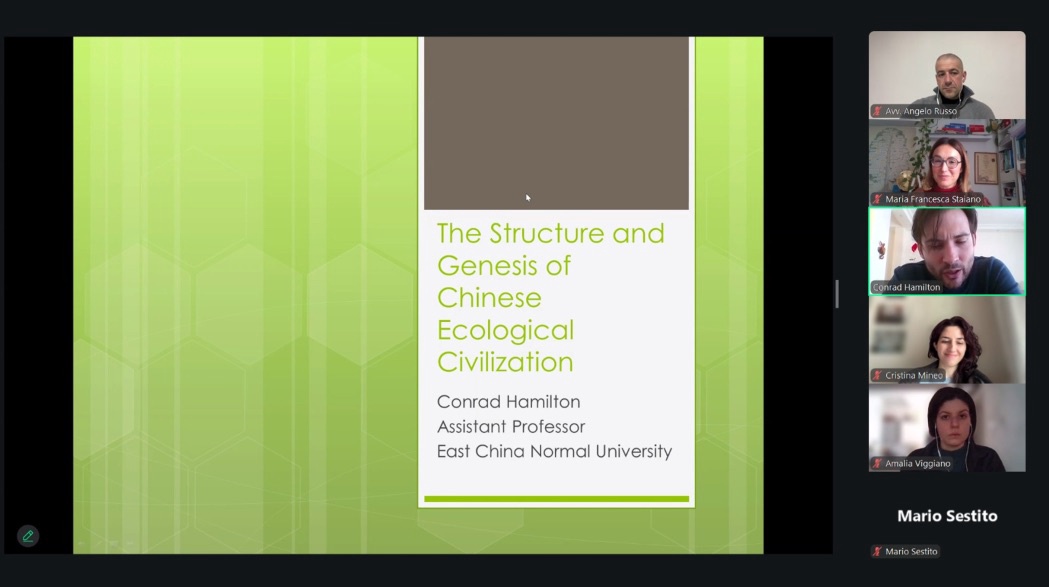
On March 6, 2026, co-director of the Center for Ecological Civilization Conrad Hamilton delivered an online guest lecture to students in the ‘Chinese Law, Legal Language and System’ Master’s program of Università degli Studi di Enna "Kore" (Kore University of Enna) at the invitation of Professor Francesca Maria Staiano. Titled “The Structure and Genesis of Chinese Ecological Civilization,” it chronicles how Chinese green development and green development philosophy reached its current state—as well as proposes possibilities for future research.
The lecture begins by drawing attention to China’s ‘prehistory’ of green development—developments that took place prior to its shift towards the adoption of formal environmental policy in 1972. These are explored with reference to ancient civilization (the Dujiangyan Irrigation System of 256 B.C, for instance) as well as the nascent environmentalism of the 1967-72 period. However, as Hamilton clarifies, it was really 1972 – and specifically, the decision to send a delegation to participate in the United Nations Conference on the Human Environment in June that year – that represented the commencement of China’s modern environmental system. He attributes this shift to three causes. First, environmental problems caused by the productivist policies of the 1949-72 period. Second, the increased industrialization of China, which naturally brought with it greater environmental harms. And third, the rapprochement of China with the relatively environmentally conscious Nixon administration, which facilitated its entry to the United Nations and consequently allowed it to partake in wide policy consultations on this subject.
In the next part of the lecture, Hamilton breaks down the historical evolution of China’s environmental policies into three categories: a first period from 1972-88, a second from 1989-98, and a third from 1998-2008. In the first, China sought to counter environmental damages stemming from the Reform and Opening Up by legally codifying environmental protections as well as making the State Environmental Protection Bureau a vice-ministerial level agency directly under the State Council. In the second, increased environmental concerns following the 1992 Southern tour led the state to adopt a legal focus that addressed itself to prevention, not just penalization, as well as to pass the first large-scale pollution control act in the history of China (the 33211 program). Notably, in this time, it also sought to bring water to standard in China’s three most polluted river basins (Huaihe, Haihe, Liaohe), published a white paper on its sustainable development goals, and made the State Environmental Protection Bureau into the State Environmental Protection Administration, upgrading it from the vice-ministerial level to ministerial level. In the third period, China responded to further emissions increases following its ascension to the WTO by taking aggressive steps in the fifth five-year plan to curb them, including by creating a strict emissions criteria for local projects, implementing subsidies for coal-fired power plants equipped with desulfurization equipment, employing inspectors and creating the Ministry of Environmental Protection, and adopting the notion of the “circular economy” (according to which “make-use-dispose” methods would be replaced by a closed-loop system).
While these were important steps, it’s really been in the post-2008 period that China has earned its reputation for global environmental leadership. Hamilton frames this shift not as top-down, but rather as being based on a synergy between policymakers and the public, in which the former sought to accommodate the demands of the latter for improved environmental stewardship as well as to leverage these against firms that had been delinquent in their handling of this issue. Another important factor guiding policy has been the increasing awareness of the economic gains associated with green technology. This has led China to achieve a dominant position in the fields of solar energy, wind energy, and electric vehicles. The development of solar energy is particularly interesting to examine for what it tells us about the fusion of environmental and economic priorities in this period. Prior to 2008, China had extensively manufactured solar panels for foreign buyers, especially German ones. But when demand collapsed after the Great Recession, it provided heavy subsidies for their domestic purchase, leading to an elevenfold increase in solar capacity from 2009-11. Today, it holds 80% of the world’s global solar manufacturing capacity—at a time when green technology is increasingly in demand worldwide.

This increased environmental bent was fully on display in the 18th Congress of 2012—an event that, building upon the 17th, elevated the idea of “ecological civilization” to major national significance. It saw the creation of a cap-and-trade emission system, the further reduction of dependency on coal-fired power plants, and the strengthening of various laws to ‘give them teeth.’ After it, more reforms followed. Major pollution and water cleanup projects were pursued, and in 2022 China committed to planting or conserving 70 billion trees by 2030. At the 19th Congress in 2017, the principal contradiction facing China was deemed to be the contradiction between unbalanced and inadequate development. 2017 also saw the launch of the “Green Belt and Road,” according to which China will work with other BRI nations to achieve environmental goals. And in 2018, the Ministry of Environmental Protection became the Ministry of Ecology and Environment and the concept of “ecological civilization” was integrated into the constitution.
Arguably most ambitious of all, for Hamilton, have been China’s emissions targets. In 2020, China committed achieving peak carbon dioxide emissions before 2030 and carbon neutrality before 2060. Adam Tooze of Foreign Policy magazine said these goals, if achieved, might “save the world.” Whether that’s true or not, China seems to be on track to fulfill them: Chinese emissions were flat or falling for 21 months after March 2024.
At the level of policy, then, there have been a number of successes. But one issue this raises, according to Hamilton, is how to develop a correspondingly robust ecological philosophy. The idea of “ecological civilization” emanated out of the Soviet environmental boom of the 1980s, which sought to revive the ecological legacy of thinkers like Vladimir Vernadsky (who pioneered the notion of the “biosphere” in the 1920s). It was then picked up by Chinese scholars starting around 1987, before gaining popularity in the culturally syncretic writings of Pan Yue—and eventually becoming state policy.
It is a truism that “ecological civilization thought” is based on a synthesis of Chinese Marxism, including the thoughts and experiences of Xi Jinping, and Chinese wisdom. It is also significant, though, to consider how it can be thought alongside contemporary global currents in ecosocialism. CEC members Jason Moore and Raj Patel have both earned renown for their model of “world-ecology.” It argues that the mistake of many environmental thinkers is to begin from the presupposition that “Nature” and “Society” are fundamentally separate entities, that must be brought into contact or harmonized with one another. For in reality, the Nature/Society divide is a construct of capitalism—one that emerged in the fifteenth century, as a means of justifying the widened expropriation of nature in order to fuel techno-scientific developments.
At the most basic level, this framework challenges us to rethink how we conceive of economic “value.” An essential condition for capitalist profits is that nature be seen as an externality—as something different from us, from which we can freely appropriate. But one of the lessons of Ecological Civilization Thought is that we cannot—in an era in which climate change threatens the future of the planet—separate environmental and economic outcomes, privileging the latter. Rather, we must factor the environment into our decision-making at every step, devising regulatory frameworks in order to offset and redirect the ecologically exploitative impulse of capitalist markets.
“Lucid waters and lush mountains are invaluable assets” goes Xi Jinping’s Two Mountains Theory. “Invaluable” here is a key word. Lucid waters and lush mountains may not have value in monetary terms. They’re invaluable: they demand a different kind of dedication.